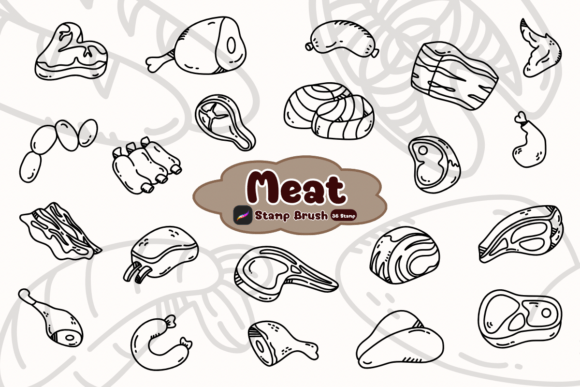
Meat: A Sketch-Style Procreate Stamp Brush for Creative Design
In the expansive ecosystem of digital illustration tools, specific asset types often solve unique workflow challenges that general-purpose brushes cannot address. Meat, a specialized set of Procreate stamp brushes, occupies a distinct niche by offering a hand-drawn, sketch-style aesthetic designed for rapid application and consistent texture. Unlike standard drawing brushes that require manual pressure control to achieve a specific look, Meat functions as a stamping tool, allowing artists and designers to replicate complex, organic textures with a single tap. This capability makes it particularly valuable for projects requiring a cohesive, artisanal feel without the time investment of drawing every element from scratch.
The Distinctive Nature of Meat in Digital Artwork
Understanding what sets Meat apart requires examining its core functionality within the Procreate environment. At its heart, this resource is a collection of pre-rendered stamp images embedded into brush engines. The defining characteristic of these stamps is their "sketch style," which mimics the irregularities of traditional media such as charcoal, graphite, or ink washes. When an artist selects a brush from the Meat set, they are not merely choosing a stroke; they are selecting a textured fragment that carries the weight of a human hand.
This distinction is crucial for maintaining visual integrity across large compositions. In a typical workflow, drawing a series of decorative elements—such as foliage, borders, or abstract shapes—can lead to inconsistencies in line weight and texture if done manually. Meat eliminates this variable. Because each stamp is identical upon placement, the resulting pattern maintains a uniform quality while still retaining the chaotic, organic appearance of a sketch. This balance between repetition and randomness is what gives the Meat brushes their unique utility. They provide the speed of a vector asset with the soul of a hand-drawn illustration.
How Meat Differs from Standard Drawing Brushes
When evaluating digital tools, it is essential to compare them against the alternatives already available in a user's toolkit. Standard drawing brushes in Procreate, such as the default Studio Pen or various chalk and pencil simulations, rely heavily on the user's input. The opacity, size, and texture density change based on the pressure and tilt of the stylus. While this offers immense freedom, it demands a high level of skill and time to produce consistent results.
In contrast, Meat operates on a different logic. It decouples the texture generation from the drawing motion. The brush head itself acts as a seal, imprinting the same design regardless of how quickly or slowly the user moves their hand (provided the spacing settings are managed correctly). This fundamental difference shifts the creative process from "drawing" to "composing." Instead of worrying about how to render a leaf or a swirl, the designer focuses on placement, layering, and composition. For professionals managing tight deadlines or clients who need multiple variations of a design, this shift in workflow can significantly reduce production time.
Evaluating Use Cases: Where Meat Shines
The versatility of the sketch style inherent in the Meat brushes makes them applicable across a wide range of creative disciplines. However, their effectiveness varies depending on the specific goals of the project. Understanding the best-fit situations helps users determine whether investing time in mastering this tool is worthwhile compared to other methods.
- Wedding Invitations and Stationery: The demand for personalized, handcrafted aesthetics in wedding stationery is high. Meat allows designers to create intricate borders, monograms, and background textures that look bespoke. The sketch style adds a touch of elegance and warmth that clean vector lines often lack, making it ideal for rustic, bohemian, or vintage-themed invitations.
- DIY Crafts and Decorations: For hobbyists creating digital patterns for fabric printing, wall decals, or scrapbooking, consistency is key. These brushes enable the creation of seamless patterns where the individual elements retain a hand-drawn charm. The ability to stamp repeatedly ensures that the final print does not look like a sterile computer-generated repeat.
- Logo Design and Branding: While logos often require clean vectors, the initial concept phase benefits greatly from the loose, expressive nature of Meat. Designers can rapidly prototype logo marks using the sketch stamps to explore organic shapes before refining them. Additionally, some brands intentionally adopt a "rough draft" aesthetic for their final identity, and these brushes facilitate that look directly.
- Creative Illustration and Storytelling: Artists working on storyboards or comic books often need to fill backgrounds quickly. Using Meat to add foliage, clouds, or architectural details can populate a scene instantly, allowing the illustrator to focus on character interaction and narrative flow.
Practical Application in Workflow
Consider a scenario where a graphic designer is tasked with creating a suite of wedding materials. The client wants a theme that feels "organic and slightly imperfect." Using standard brushes, the designer might spend hours drawing a single floral motif, struggling to make the second one match the first without looking identical. By utilizing Meat, the designer can select a stamp that matches the desired aesthetic and apply it dozens of times. They can then rotate, scale, and adjust the opacity of individual stamps to create depth and variation. The result is a composition that looks labor-intensive but was executed with remarkable efficiency.
Tradeoffs and Limitations to Consider
While Meat offers significant advantages in speed and texture consistency, it is not a universal solution. Like any specialized tool, it comes with tradeoffs that must be weighed against the project requirements. A critical evaluation of these limitations is necessary for making an informed decision.
One primary limitation is the potential for overuse. Because stamping is so easy, there is a risk of creating designs that appear repetitive or "stamped" in a negative sense. If a user places the same element too frequently without altering its properties, the work can lose its organic feel and start to look mechanical. To mitigate this, skilled users must actively manipulate the rotation, size, and blending modes of the stamps to introduce natural variation. This requires a degree of artistic judgment that simply having the brush does not automatically provide.
Furthermore, the resolution and scalability of stamp brushes can present challenges. Since Meat consists of raster-based images, scaling them up excessively for large-format prints may result in pixelation or loss of detail. Unlike vector graphics, which can be scaled infinitely without degradation, these brushes have a fixed resolution. Users must ensure that the source stamps are of sufficient quality for their intended output size. For projects requiring extreme scalability, such as billboards or massive banners, a vector-based approach or a higher-resolution alternative might be more appropriate.
Comparing with Vector Alternatives
When comparing Meat to vector clip art or SVG assets, the choice often comes down to the desired aesthetic versus technical flexibility. Vector assets offer perfect scalability and easy color changes, making them superior for corporate branding or technical illustrations. However, they often lack the textural nuance of the sketch style found in Meat. Vectors tend to look clean and precise, whereas the stamp brushes capture the grit and imperfection of traditional media. If the goal is to evoke emotion, nostalgia, or a handmade quality, the raster-based nature of these brushes is actually a feature, not a bug.
Decision Factors: Is Meat the Right Choice?
Determining whether Meat fits into your creative arsenal depends on several factors, including your current workflow, the nature of your projects, and your proficiency with Procreate. If you are an illustrator who spends a significant amount of time rendering repetitive textures manually, these brushes can serve as a powerful productivity booster. They allow you to bypass the tedious aspects of texturing and focus on the broader composition.
However, if your work primarily involves technical drawing, UI/UX design, or projects requiring strict geometric precision, Meat may not be the most efficient tool. Its strength lies in its looseness and organic variability, which can sometimes conflict with the rigid requirements of functional design. Similarly, if you are new to digital art and rely heavily on automatic features to generate content, you may find that the lack of dynamic pressure response in stamp brushes limits your expressiveness compared to traditional drawing brushes.
Ultimately, the value of Meat lies in its ability to bridge the gap between the speed of digital production and the warmth of analog artistry. It is a tool for those who appreciate the texture of a sketch but need the efficiency of modern technology. By understanding its strengths, recognizing its limitations, and applying it judiciously within appropriate contexts, creators can leverage these brushes to enhance their portfolios and deliver high-quality, distinctive results. Whether for a wedding invitation that needs a personal touch or a DIY craft project that demands unique patterns, Meat provides a reliable method for achieving a professional, hand-crafted look.